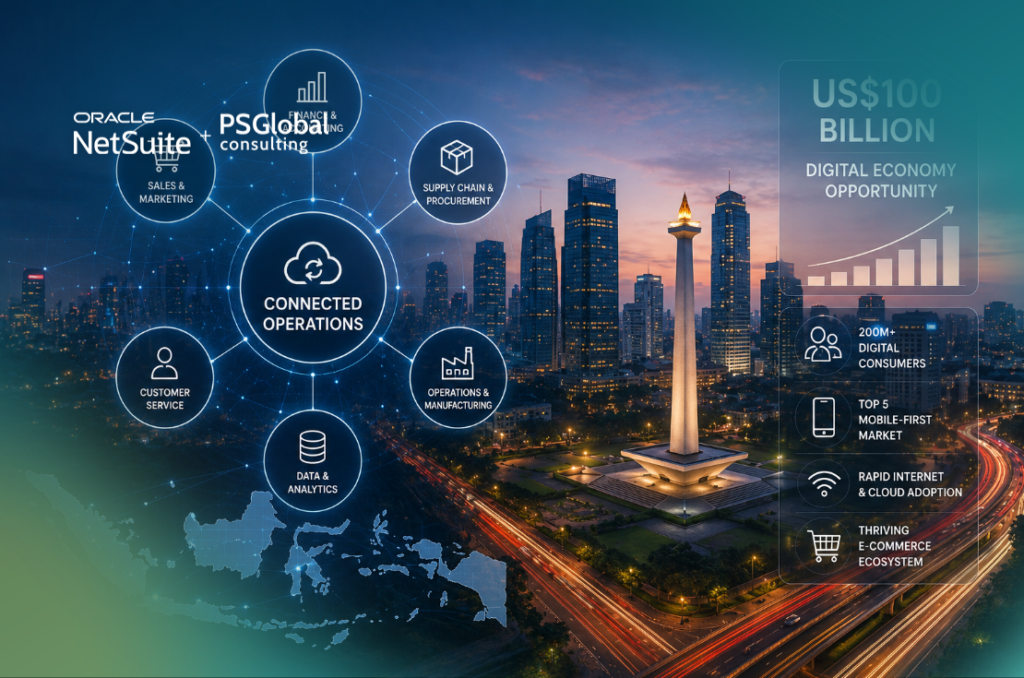
Indonesia is now home to the largest digital economy in Southeast Asia. According to the e-Conomy SEA 2025 report by Google, Temasek and Bain & Company, the country’s digital economy grew 14% year on year to reach nearly US$100 billion in gross merchandise value (GMV) in 2025, with projections pointing towards roughly US$180 billion by 2030. Behind these headline numbers lies a quieter, far less celebrated story: the operational strain this growth is placing on the businesses driving it.
Every new sales channel, payment method and logistics partner adds another system to the stack. Each one solves a problem in isolation. Together, they create fragmentation. This explains why business system integration in Indonesia has shifted from a nice-to-have IT project into a board-level growth decision.
The Scale of the Boom, by the Numbers
The growth is broad-based and accelerating across every layer of digital commerce:
- E-commerce GMV reached US$71 billion in 2025 and could surpass US$100 billion by 2026, keeping e-commerce the single largest contributor to the digital economy.
- Digital payments have gone mainstream. Bank Indonesia recorded 6.05 billion QRIS transactions worth around US$37 billion in the first half of 2025 alone, supported by 39.3 million registered merchants.
- Video commerce has exploded, with transaction volumes up 90% year on year to 2.6 billion and around 800,000 sellers now active on video platforms.
Each of these figures represents a revenue opportunity. Each also represents another platform, another data format and another reconciliation task for the finance and operations teams behind the scenes.
Growth is Happening Across Fragmented Platforms
The typical growing Indonesian business now sells through marketplaces such as Shopee and Tokopedia, runs a TikTok Shop storefront, accepts QRIS and e-wallet payments, manages customers in a CRM, runs campaigns through marketing automation tools, and coordinates delivery through multiple logistics applications. Globally, the picture is the same: the average organisation now runs 106 SaaS applications, and large enterprises run far more.
The problem is how little of this stack talks to itself. Salesforce’s 2025 MuleSoft Connectivity Benchmark Report found that organisations use an average of 897 applications, yet only 29% of those applications are connected. The same study found that 90% of IT leaders say data silos are creating business challenges, and that IT teams spend around 39% of their time building and testing custom integrations between systems.
What Fragmentation Actually Costs
When systems operate in isolation, three predictable costs emerge:
Data silos across departments
Sales data lives in the marketplace seller centres, payment data sits with the payment gateways, customer data sits in the CRM, and stock data sits in a warehouse application. Nobody holds a single, current view of the business. Decisions get made on exports that were already outdated when they were downloaded.
Manual operational processes
Staff re-key orders from one system into another, copy tracking numbers between portals, and maintain spreadsheets that exist purely to bridge software that should be bridging itself. Manual processes scale linearly with transaction volume, meaning headcount grows in step with orders, and margins erode as revenue rises.
Duplicate workflows and reconciliation work
Every platform settles on its own schedule, net of its own fees, in its own format. Finance teams spend days matching marketplace settlements against bank deposits and internal records. Research covered by CFO.com found that half of finance teams take more than six business days to close the books, with reconciliation consuming 20 to 50 hours per month across three to five different systems.
Integration Has Become a Necessity for Scale
At low volumes, fragmentation is an inconvenience. At digital-economy volumes, it becomes the constraint on growth itself. The businesses that will capture Indonesia’s projected US$180 billion opportunity are the ones treating business system integration in Indonesia as core infrastructure, on the same level as their warehouses and their working capital.
We break the challenge into three pressure points, each of which we explore in depth in its own article within this series:
- System sprawl and data silos. Indonesia’s digital boom is multiplying the platforms businesses depend on. Integration platforms such as Celigo and Workato connect them and automate the workflows in between.
- Financial control. Revenue is arriving from more sources than finance systems were designed for. Oracle NetSuite, extended with Netgain, centralises financial reporting across all platforms and entities.
- E-commerce backend strain. High order volumes, multi-channel selling and complex fulfilment are breaking order-to-cash processes. Connecting e-commerce platforms to the ERP restores end-to-end visibility.
Why Choose PS Global
As a multi-year winner of NetSuite’s Asean Partner of the Year award, PS Global has helped businesses across Indonesia and Southeast Asia replace fragmented stacks with a connected core. We implement NetSuite as the financial and operational backbone, deploy integration platforms such as Celigo and Workato to connect e-commerce, payments, CRM and logistics systems, and extend financial automation with solutions such as Netgain.