


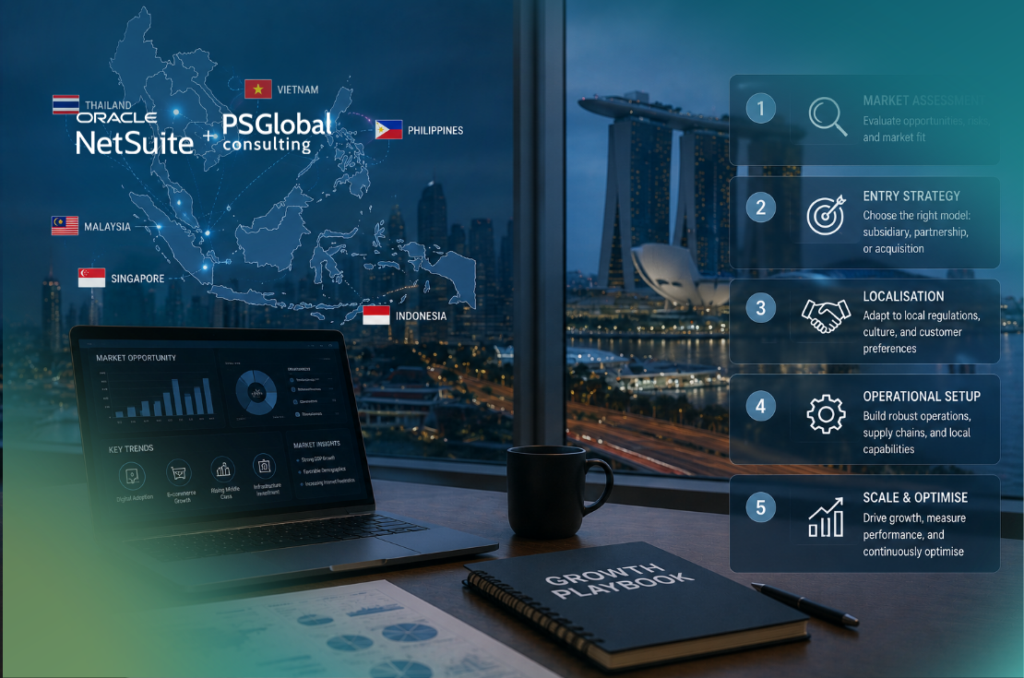
For a growing number of Australian and New Zealand (ANZ) companies, the next chapter of growth is being written in Southeast Asia. The region sits on the doorstep, the trade agreements are mature, and the demand signals are strong. The opportunity is real, the timing is favourable, and the groundwork has never been more accessible.
Getting there well takes more than ambition. Southeast Asia is ten distinct economies with their own tax codes, languages, currencies, and reporting rules. Companies that plan the operational and financial groundwork early tend to scale faster and with fewer surprises. This guide sets out the case for expanding into Southeast Asia, the tailwinds working in your favour, and the practical foundations that separate a smooth regional rollout from a stalled one.
Why Southeast Asia Is on Every ANZ Growth Agenda
Southeast Asia is home to more than 680 million people and ranks as the world’s fifth-largest economy, with a combined output exceeding US$3.8 trillion. Asean Briefing describes it as a growth corridor of rising incomes, rapid urbanisation, and an expanding middle class. The momentum is especially visible in the digital economy.
The 2025 e-Conomy SEA report by Google, Temasek, and Bain & Company found that the region’s digital economy is on track to surpass US$300 billion in gross merchandise value (GMV) in 2025, up from around US$40 billion a decade ago, with revenue forecast to reach US$135 billion. E-commerce alone is projected to hit US$185 billion in GMV. For ANZ exporters and software, services, and consumer brands, that is a fast-maturing market sitting a few hours north.
Governments on both sides of the Tasman Sea have made the region a strategic priority. Australia’s Invested: Australia’s Southeast Asia Economic Strategy to 2040 projects Asean to become the world’s fourth largest economy by 2040. In 2024 alone, two-way trade between Australia and Southeast Asia grew by almost A$6 billion, and by the end of 2025, the Australian government had run 21 business and investment missions carrying more than 500 businesspeople into the region, according to a review of the strategy’s first two years.
New Zealand is moving in the same direction. According to the Ministry of Foreign Affairs and Trade, two-way trade with Asia topped NZ$93 billion in 2024 to 2025, with 43% of exports heading to Asian markets. New Zealand’s food and beverage exports to Asean reached NZ$8.4 billion by 2025, almost double the value of a decade earlier, as reported by AP Food online. Asean now stands as one of New Zealand’s most important food and beverage export regions.
The Trade Tailwinds Making the Move Easier
ANZ companies enter Southeast Asia with a structural advantage built over fifteen years. The ASEAN–Australia–New Zealand Free Trade Area (AANZFTA), in force since 2010, has seen nearly all goods move duty-free, and New Zealand’s trade with Asean under the agreement has climbed from around US$7.3 billion to close to US$17 billion. The deal also streamlines rules of origin, so manufacturers can source components across member countries and still qualify for preferential treatment.
Layered on top is the Regional Comprehensive Economic Partnership (RCEP), the world’s largest free trade agreement, which links Asean with China, Japan, South Korea, Australia, and New Zealand. With Timor-Leste joining Asean as its eleventh member in 2025, the bloc is consolidating into a single, deeply connected economic ecosystem. For an ANZ business, these agreements lower tariffs, simplify cross-border supply chains, and reduce friction in trading across multiple jurisdictions simultaneously.
What Actually Makes Southeast Asia Hard
The scale of Southeast Asia comes with genuine complexity. The region is many markets in one, each with its own rules on taxes, foreign ownership, employment, and reporting. As Asean Briefing puts it, expansion here works best as a sequencing decision across markets, with Singapore serving as a regional base, Vietnam and Malaysia supporting manufacturing, and Indonesia and the Philippines offering large consumer markets.
Tax and E-Invoicing Mandates Are Moving Fast
Regulators across the region are digitising tax in real time, and deadlines are approaching quickly. In Malaysia, the MyInvois e-invoicing mandate uses a clearance model where each invoice is validated by the tax authority before it reaches the buyer. The mandate became compulsory for businesses with turnover above RM25 million from January 2025 and above RM5 million from July 2025, with later phases extending further down the size scale.
In Indonesia, the Coretax system reached full nationwide enforcement by 31 December 2025. Under Coretax, clearance becomes a legal precondition for issuing a VAT invoice, and an invoice that has not been validated cannot support input tax recovery. The system supports host-to-host integration, enabling enterprise taxpayers to connect their ERP directly to the tax authority. These mandates make the link between a company’s finance system and local tax rules a frontline operational concern.
Every Market Has Its Own Rulebook
Beyond tax, the operating rules differ sharply between countries. As People Profilers notes, statutory contribution schemes vary across the region, with EPF in Malaysia, BPJS in Indonesia, and Social Security in Thailand, each carrying its own rates and filing obligations. Indonesia and the Philippines mandate a thirteenth-month salary. Payroll runs across several currencies. Local termination rules, leave entitlements, and contract requirements rarely transfer cleanly from one country to the next. A plan that works in Singapore will need to be adapted for Vietnam or Indonesia.
The Operational Layer: Most Expansion Plans Underestimate
Market research, distribution, and hiring usually get attention early. The financial and systems backbone often gets attention late, and that is where expansion plans tend to slow down. When a company operates across five or more markets, the finance team faces multiple currencies, tax regimes, statutory reports, and e-invoicing platforms simultaneously. Spreadsheets and disconnected local systems struggle under that load.
One System, Many Jurisdictions
A cloud ERP such as Oracle NetSuite is built for exactly this situation, with multi-subsidiary, multi-currency, and multi-tax management designed to consolidate a regional business into one source of truth. For ANZ companies that already run NetSuite at home, the platform can extend to new Southeast Asian entities, ensuring that group reporting, intercompany transactions, and consolidated financials remain coherent as the footprint grows.
Localisation Is Where Rollouts Succeed or Stall
Owning the right platform is the start. Making it speak each country’s language, currency, and compliance rules is where the value is realised. NetSuite localisation aligns the system with local tax formats, e-invoicing clearance models like MyInvois and Coretax, statutory reporting templates, and country-specific document layouts. A well-localised rollout turns a global platform into a compliant local operation in every market. A poorly localised one creates manual workarounds, reporting gaps, and audit risk that compound with every new entity.
A Practical Sequencing Approach for ANZ Companies
A measured, phased approach gives the best odds of a clean regional expansion. Most successful ANZ rollouts follow a path close to this:
- Choose a beachhead market. Pick the first country based on commercial intent, whether that is sales reach, manufacturing capacity, or a regional headquarters, then build outward from there.
- Review the existing system. Assess whether the current ERP setup can carry additional subsidiaries, currencies, and tax regimes before adding load to it.
- Localise for compliance. Configure tax codes, e-invoicing integration, and statutory reporting for each target market ahead of go-live.
- Integrate the surrounding tools. Connect payroll, banking, logistics, and any industry systems so data flows cleanly across the group.
- Train the local teams. Equip finance and operations staff in each country to run the system confidently from day one.
Sequenced this way, expansion becomes a series of controlled, repeatable steps that the business can scale across the region with growing confidence.
How PS Global Consulting Supports ANZ Companies in the Region
At PS Global Consulting, we partner with companies across Australia and New Zealand to make their NetSuite footprint work harder across Southeast Asia. As an Oracle NetSuite Solution Provider operating throughout the region, we bring local presence, regional knowledge, and deep platform expertise to every engagement.
Our services for the ANZ market are built around helping you get more from the system you already run. We deliver NetSuite support, enhancements, and system reviews that keep your platform healthy. We handle the integrations, localisations, and Asia rollouts that carry your operations confidently into new markets. We provide NetSuite training that turns your teams into capable system owners. We also build in-house enhancements, including our enhanced reporting for food and beverage businesses, where regional consolidation and product-level visibility matter most.
Our focus across Australia and New Zealand is firmly on services that extend and optimise your NetSuite investment as you grow into Southeast Asia. We help you localise with precision, integrate with discipline, and roll out with momentum.
Southeast Asia rewards the prepared. Build the foundation well, and the region opens up.