Introduction
Singapore’s AI ambitions are accelerating quickly. The island state is investing heavily in artificial intelligence, cloud infrastructure, high-performance computing, and enterprise digitisation. In January 2026, Singapore announced plans to invest more than S$1 billion in public AI research through 2030, reinforcing its ambition to strengthen national capabilities and global competitiveness.
Private sector investment is also intensifying. Microsoft announced that it is on track to spend US$5.5 billion on cloud and AI infrastructure and operations in Singapore from 2025 to 2029. Amazon Web Services had earlier said it would invest S$12 billion, or about US$9 billion, to expand cloud infrastructure in Singapore.
Across Southeast Asia, the broader digital economy is also entering its AI phase. The 2025 e-Conomy SEA report by Google, Temasek, and Bain & Company found that Southeast Asia’s digital economy is set to surpass US$300 billion in gross merchandise value in 2025.
These numbers point to one clear trend: AI adoption and digital infrastructure investment are moving fast.
For businesses, the next challenge is more practical. Can their finance, reporting, and operational systems keep up?
The AI Boom Is Moving Faster Than Internal Systems
Across industries, companies are rapidly deploying AI tools.
These include:
- AI copilots and agents
- Automation tools
- AI-powered customer engagement platforms
- Predictive analytics systems
- Data-driven decision-making tools
McKinsey’s 2025 State of AI survey found that 88% of respondents reported regular AI use in at least one business function, up from 78% the previous year. This shows that AI has moved from experimentation into everyday business activity.
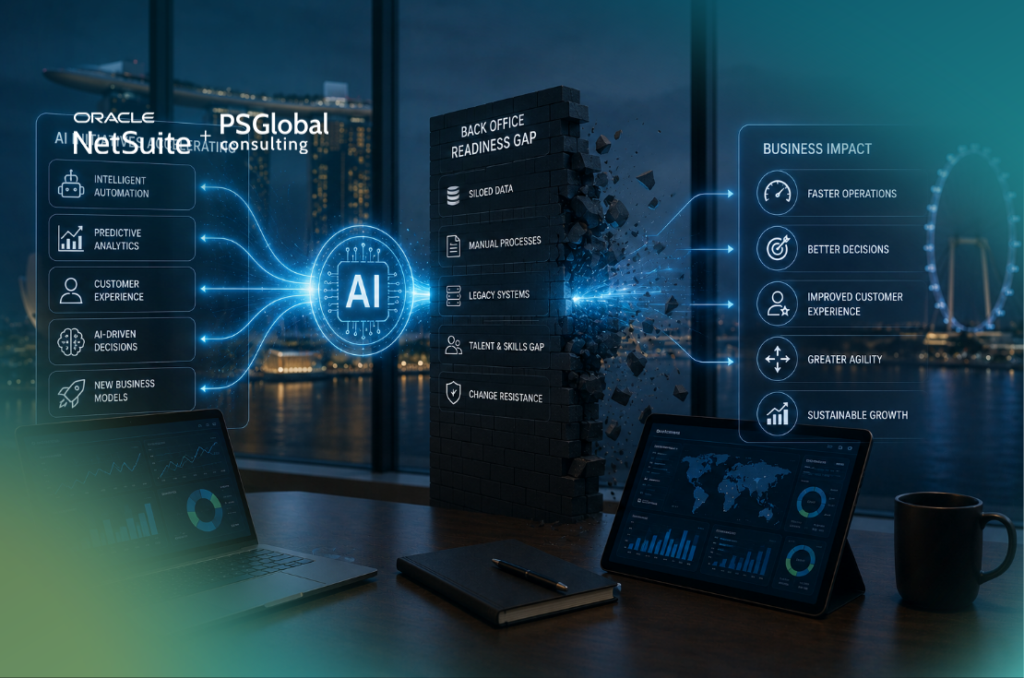
However, many organisations are discovering that AI adoption is easier than AI operational readiness.
AI tools need clean, timely, and connected data. They also need business processes that can support faster decisions, automated workflows, and cross-functional visibility. Yet many companies still operate with fragmented finance systems, disconnected operational platforms, manual reporting processes, and siloed business data.
This creates a gap between front-end AI adoption and back-office readiness.
A company may have AI tools for sales, customer service, marketing, analytics, or forecasting. Yet if finance teams are still consolidating numbers manually, if operational data sits across multiple systems, or if reporting depends on spreadsheets, AI will struggle to deliver enterprise-wide value.
Why Back-Office Readiness Matters for AI
AI does not work well in isolation. Its usefulness depends on the quality of the systems behind it.
IBM Institute for Business Value research highlights that organisations are increasingly recognising that AI success depends on more than technology deployment. Effective governance, trusted data, workforce readiness, and integration into core business processes are emerging as critical factors in achieving value from AI initiatives.
This matters because most business decisions are cross-functional.
For example:
- A sales forecast depends on customer demand, pricing, inventory, and finance data
- A procurement decision depends on supplier performance, cash flow, inventory, and margin visibility
- A finance forecast depends on revenue, cost, billing, collections, and project performance
- A customer service response depends on order history, fulfilment, payments, and support data
If these systems are disconnected, AI may generate insights that are incomplete, delayed, or difficult to act on.
This is where AI operational readiness becomes critical. Businesses need the ability to connect data, standardise reporting, automate workflows, and access real-time visibility across departments.
Finance Teams Are Feeling the Pressure
Finance teams are expected to support faster decisions, stronger governance, better forecasting, and AI-enabled reporting. Yet many finance functions still rely heavily on manual tools.
CFO Connect’s 2025 survey of finance leaders found that AI adoption in finance nearly doubled from 31% in 2024 to 56% in 2025. At the same time, the same report found that 71% of companies still rely on spreadsheets for financial planning and analysis.
This creates a difficult operating reality.
Finance teams are being asked to participate in AI transformation while still managing:
- Manual reconciliations
- Spreadsheet-driven planning
- Delayed month-end reporting
- Multiple sources of financial data
- Limited real-time visibility into performance
This is why AI can sometimes expose weaknesses in the back office. The more a company wants to automate and analyse, the more it needs reliable and connected business data.
The Cost of Fragmented Systems
Fragmented systems create several business risks.
Poor data quality
AI depends on accurate data. If finance, operations, sales, and inventory data are inconsistent, AI outputs may become unreliable. This weakens confidence in automated insights and slows adoption.
Slow reporting
AI can generate insights quickly, but those insights lose value if the underlying financial and operational data is outdated. Businesses need real-time reporting to respond effectively to fast-changing conditions.
Manual work
Disconnected systems often require employees to manually transfer data between platforms. This increases the risk of errors and reduces the productivity gains that AI is supposed to create.
Limited governance
As AI becomes embedded into business operations, companies need stronger auditability, approval workflows, and data governance. Fragmented systems make it harder to control who uses what data and how decisions are made.
Difficulty scaling AI
AI pilots can run on limited datasets. Enterprise-wide AI requires connected systems, standardised workflows, and reliable reporting across business functions.
AI Readiness Requires a Unified Business Backbone
For businesses in Singapore and Southeast Asia, AI operational readiness starts with a stronger digital foundation.
A unified business backbone can help organisations:
- Centralise financial and operational data
- Improve reporting accuracy
- Reduce manual reconciliation
- Support real-time decision-making
- Strengthen governance and auditability
- Scale AI initiatives across departments
This is where cloud ERP becomes strategically important.
Oracle NetSuite is a unified system designed to connect different parts of an organisation, centralise data, and provide complete visibility across the business. NetSuite is also a single source of data, creating a stronger foundation for AI-powered insights and actions through its embedded AI capabilities.
For businesses facing AI-driven complexity, this foundation matters. A company cannot fully benefit from AI if its operational data remains scattered across spreadsheets, legacy tools, and disconnected platforms.
Real-Time Visibility Is Becoming a Competitive Advantage
In Singapore’s AI-driven economy, speed matters.
Businesses need to respond quickly to:
- Changing customer behaviour
- Supply chain disruption
- Cost volatility
- Cross-border expansion
- Compliance requirements
- New market opportunities
Real-time visibility enables leadership teams to act faster and with greater confidence.
NetSuite’s SuiteAnalytics provides real-time visibility into operational and financial performance across business functions, with dashboards, reports, and KPIs that help companies monitor business performance.
For finance and operations leaders, this kind of visibility can support:
- Faster month-end close
- Better cash flow monitoring
- Stronger cost control
- More accurate forecasting
- Improved profitability analysis
As AI adoption grows, real-time visibility becomes increasingly important because AI systems depend on up-to-date, accurate business data.
Where Netgain Fits Into the AI-Ready Finance Function
As companies modernise their finance functions, they also need deeper control over accounting processes, reconciliations, lease accounting, and close management.
Netgain is a NetSuite-native accounting software designed to automate lease accounting, reconciliations, and close processes. For businesses using NetSuite, Netgain can support finance teams seeking greater accuracy, efficiency, and control in their accounting workflows.
This is important in an AI-ready finance environment.
AI can help analyse patterns and accelerate decision-making, but finance still requires:
- Accurate accounting records
- Controlled close processes
- Strong audit trails
- Consistent reconciliations
- Reliable financial reporting
A stronger financial foundation allows AI-driven insights to be built on data that leaders can trust.
What AI Operational Readiness Looks Like
AI operational readiness is not a single technology project. It is a business capability.
An AI-ready organisation typically has:
Connected systems
Finance, sales, operations, inventory, procurement, and customer data should flow across systems with minimal manual intervention.
Clean and reliable data
AI models and analytics tools need accurate data to produce useful insights.
Real-time reporting
Decision-makers need current information, not reports that arrive days or weeks late.
Automated workflows
Manual processes slow down AI-enabled operations. Automation allows businesses to respond faster and reduce repetitive work.
Strong governance
AI adoption requires clear controls, audit trails, and data access policies.
Scalable platforms
As businesses grow, their systems must support higher transaction volumes, more entities, more markets, and more complex reporting requirements.
AI Ambition Needs Operational Discipline
Singapore’s AI investment push creates a significant opportunity for businesses.
Government funding, hyperscaler investment, and regional digital economy growth are creating an environment where companies can adopt AI faster than ever. However, speed alone will not guarantee business value.
The real winners will be the companies that pair AI ambition with operational discipline.
That means modernising the systems that run the business:
- Finance
- Reporting
- Operations
- Procurement
- Billing
- Inventory
- Compliance
Businesses that invest in AI without strengthening their back office may find themselves with advanced tools sitting atop fragmented processes.
Businesses that strengthen their operational backbone will be better positioned to turn AI into measurable business performance.
Who Is PS Global Consulting?
PS Global Consulting is Asia’s leading Oracle NetSuite consultancy with deep expertise across cloud ERP implementation, automation, integration, and regional localisation.
PS Global supports organisations across Singapore, Indonesia, Thailand, Malaysia, Vietnam, the Philippines, Hong Kong, and wider Asia-Pacific markets.
Its capabilities include:
- Oracle NetSuite ERP implementation
- Financial transformation
- System integration
- Workflow automation
- Localisation and compliance enablement
- Multi-country cloud transformation projects
PS Global also works closely with technology partners, including Oracle NetSuite, Celigo, Workato, and Netgain, to help businesses modernise operations and improve visibility across increasingly complex regional environments.
As AI adoption accelerates, businesses need more than standalone tools. They need connected systems, trusted data, and scalable operations. PS Global helps organisations build the operational foundation required to turn AI ambition into business impact.
Conclusion
AI is moving quickly across Singapore and Southeast Asia. Businesses are adopting copilots, agents, automation platforms, and AI-powered analytics at speed. Yet many are still held back by fragmented finance systems, disconnected operations, manual reporting, and siloed data.
This is the central challenge of AI operational readiness. AI can accelerate business performance only when the back office is ready to support it. Companies need unified systems, real-time visibility, automated workflows, and reliable financial data.
For Singapore businesses, the message is clear: AI transformation begins with operational readiness.