Introduction
Singapore has built its prosperity on trade. As a regional headquarters hub, a financial centre, and one of the world’s busiest ports, the country sits at the crossroads of Asian commerce. That position is now being tested by a more turbulent global environment, where supply chain volatility, energy risk, and geopolitical fragmentation arrive in quick succession and often together.
Global merchandise trade reached about US$35 trillion in 2025 even amid tariff uncertainty and geopolitical tension, and supply chains are being redesigned to fragment and adapt to new conditions. Singapore is central to that redesign, handling roughly US$1 trillion in merchandise trade and US$800 billion in services trade in 2024 as a strategic gateway to an Asean market of more than 650 million consumers.
For businesses coordinating operations from Singapore, the challenge is operational as much as strategic. Static monthly reporting and spreadsheet-based forecasting were built for a steadier world. The task now is to see what is happening across the business in real time and act quickly.
A More Volatile World for Singapore Businesses
Three forces are reshaping how companies in Singapore plan and operate. Each one adds complexity, and together they raise the cost of slow, disconnected information.
The first is trade realignment. Under China Plus One strategies, United States goods imports from China fell 29.7% in 2025 to US$308.4 billion, as production spread across the region. Tariff policy has become a live variable, with the United States announcing sweeping reciprocal tariffs in April 2025 that initially reached 46% on Vietnam and 24% on Malaysia, before later being negotiated.
The second is disruption itself. Supply chain research indicates that 94% of companies have experienced a revenue impact from disruptions, while only 6% report full visibility across their supply chains. The third is strategic response, with Deloitte finding that 71% of chief executives plan to alter their supply chains over the next three to five years.
China Plus One Is Reshaping Regional Supply Chains
The move to diversify sourcing away from a single country has accelerated. Companies are adding manufacturing and supplier nodes across Vietnam, Thailand, Indonesia, Malaysia, and beyond, while keeping their coordination and financing functions in Singapore.
China’s trade surplus with Asean reached a record US$276 billion in 2025, a reminder that diversification is layering new nodes onto existing China-centred chains rather than replacing them. An earlier McKinsey analysis noted that 88% of Southeast Asian trade flows remain within Asia Pacific, keeping regional coordination at the heart of the story.
Singapore anchors that coordination. Global firms treat the country as a regional headquarters hub and a platform for coordinating capital, data and supply chains across Asia. Recent arrivals illustrate the pattern, with Meiji and MÜNZING establishing regional headquarters in Singapore to oversee multiple Southeast Asian entities from one base.
The operational consequence is straightforward. A Singapore-headquartered business now runs more legal entities, in more countries, across more currencies and tax regimes than it did a few years ago. Every new node multiplies the systems that need to be kept in step.
Energy Risk Is a Direct Input to Singapore’s Cost Base
Singapore imports more than 95% of its energy, with natural gas making up 93.1% of the electricity fuel mix in the first half of 2025. Wholesale electricity prices ranged between S$100 and S$200 per megawatt-hour throughout 2025, and for energy-intensive industries, a sustained rise in global energy prices can lift total operating costs by 2% to 6%.
The national energy regulator has been candid, advising that businesses should be prepared for higher, more volatile energy costs as gas prices track oil prices. Domestic policy adds a further known increase, with the carbon tax rising from S$25 to S$45 per tonne between 2026 and 2027, with a stated trajectory toward S$50 to S$80 per tonne by 2030.
For manufacturers, logistics operators, and data centre users, energy is a material line in the cost base. When it moves, procurement costs, production margins, and forecasting accuracy all move with it. Businesses that can model those effects quickly hold a real advantage over those that discover them at month-end.
Static Reporting Cannot Keep Pace
The common thread across trade, energy, and geopolitics is speed. Conditions change faster than traditional finance and operations processes can keep pace with. The evidence suggests many businesses are still working with tools built for a slower era.
AFP’s 2025 FP&A Benchmarking Survey found that 96% of finance professionals still rely on spreadsheets as their primary planning tool, and only 23% use AI in forecasting on a regular basis. The cost of that lag is high: industry research shows that 82% of companies make decisions based on stale information, and 61% of chief financial officers cite inaccurate forecasting as the single biggest barrier to controlling costs.
In a volatile market, a forecast that is weeks old is already wrong. Decisions on pricing, procurement, hedging, and investment depend on numbers that reflect the business as it is today.
Real-Time Operational Visibility Is the New Requirement
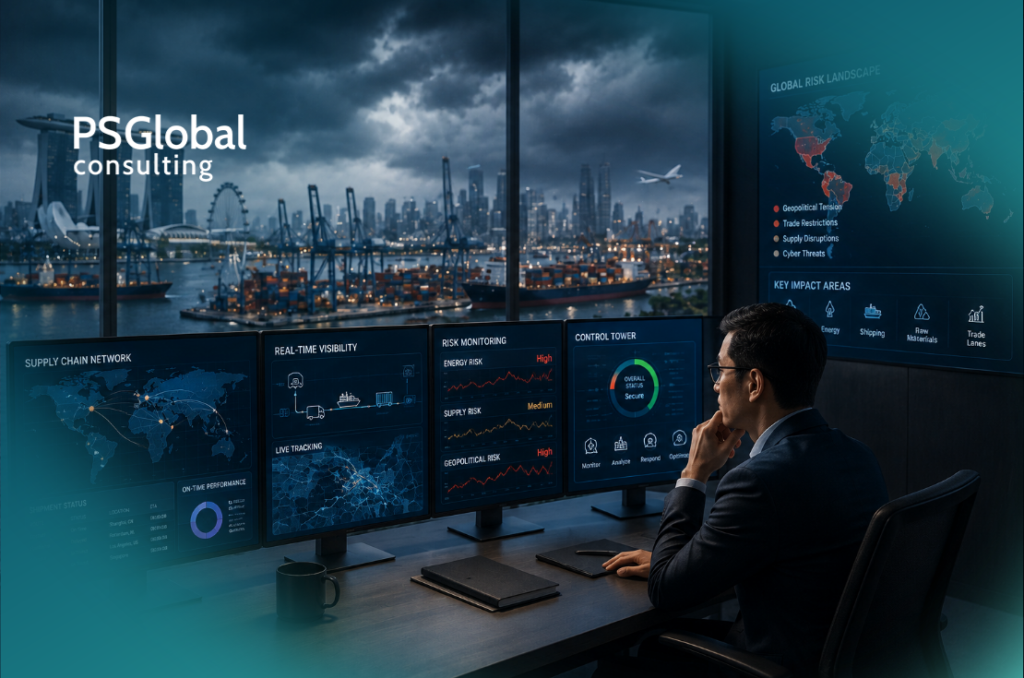
The response to volatility is a connected operational core that provides leaders with a current view of the business. That core rests on a modern cloud ERP, clean integration across systems, disciplined financial control, and, increasingly, AI that can act on the data.
Oracle NetSuite provides the unified backbone, bringing finance, operations, inventory, and multi-entity reporting into a single system. Netgain strengthens the accounting layer with automated reconciliations and close management. AI and intelligent agents then turn real-time data into faster decisions and automated responses.
Why Choose PS Global Consulting?
PS Global Consulting is one of Southeast Asia’s leading Oracle NetSuite consultancies and digital transformation partners, headquartered in Singapore, with deep expertise across cloud ERP implementation, automation, integration, and regional localisation.
From its Singapore base, PS Global supports organisations across Singapore, Indonesia, Thailand, Malaysia, Vietnam, the Philippines, Hong Kong, and wider Asia Pacific markets. Its capabilities include Oracle NetSuite ERP implementation, financial transformation, system integration, workflow automation, localisation and compliance enablement, and multi-country cloud transformation projects.
PS Global works closely with technology partners, including Oracle NetSuite, Celigo, Workato, and Netgain, to help Singapore businesses build the connected, real-time operational core that volatility now demands.
Conclusion
Supply chain volatility, energy risk, and geopolitical fragmentation are enduring features of the environment in which Singapore businesses operate. The companies that navigate them well will be those that can see across their operations in real time and act with confidence. That capability begins with connected systems, trustworthy data, and a financial core built for speed.